
AI & Marketing Now
AI for Developing Countries
Artificial Intelligence is emerging as a powerful equalizer for developing countries, offering innovative solutions to bridge critical gaps in healthcare, education, and agriculture that have long hindered economic progress.
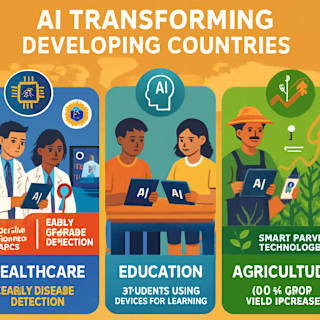
Healthcare access
Machine learning algorithms are revolutionizing disease detection in regions with limited medical infrastructure. In minutes, rather than days, these models can accurately diagnose conditions like malaria, tuberculosis, and cervical cancer from medical images or blood tests. These AI diagnostic tools are particularly crucial given the projected shortage of 10 million healthcare professionals globally by 2030, with significant gaps expected across sub-Saharan Africa. (sources)
Agricultural AI applications
Smart farming technologies are increasing crop yields and livelihoods across developing regions through data-driven insights and predictive analytics. Rajesh, a farmer from rural India, increased his harvest by 40% using AI tools that analyze weather patterns and soil conditions, bringing financial stability that allowed him to reinvest in his farm. In South Africa, Kelebogile Mosime manages her 21-hectare vegetable farm using AI-Farmer. This application supports local languages, including Setswana, isiZulu, and Afrikaans, to help diagnose plant diseases and provide pest control recommendations. (sources)
Closing education gaps
Educational gaps are being addressed through AI-powered learning platforms and multilingual chatbots that deliver personalized instruction in students’ native languages and cultural contexts. With the United Nations projecting a need for 44 million additional teachers by 2030—a third of whom will be required in sub-Saharan Africa—these AI educational tools are essential for bridging teacher shortages. India’s government is developing Bhashini, an AI translation system designed to work across the country’s 22 official languages, few of which are currently supported by standard AI applications.
Consumers in these countries should see more rapid economic growth, improved health, and better education. These developments have important implications for marketing to consumers in developing countries. (sources)